2 quick things:
Thing 1:
There's no mechanism that informs me when someone has made a comment on a post, so if I don't seem to get around to in a timely fashion, that's why. I do appreciate comments, however, so don't hesitate!
Thing 2:
Deciphering katakana can always be a little tricky- in the last post I thought a lantern belonged to J-media karu (meaning of karu unknown). It's actually "J-medical" (jeimedeikaru).
Tuesday, April 21, 2009

Sunday, April 19, 2009
Hanami Festival in Joetsu
For all the PNG stuff that is (and yet shall) go up, this is still a Japan blog after all, so I thought I should post something Japanese just to shake things up.
A hanami (花見) party/festival simply means "flower viewing," and flower viewing is what you do. Early April is the time to get out and engage in the time-honored tradition of looking at sakura (cherry blossoms), which aside from the chrysanthemum, are probably the most recognizable symbol of Japan, as far as flowers go. I also appreciate that there's still a country somewhere in the world where people will turn out in droves more or less solely for the purpose of looking at flowers. In many regards, Japan's general philosophy is not one that encourages one to "stop and smell the roses," and the country's ecological record leaves much to be desired. All the same, if only for this festival, all of Japan meandered outdoors to look at the cherry blossoms. And get massively drunk (but some things just don't change from event to event in this country).
The festival also brought home the fact that we were, indeed, back in Japan. Still fresh from PNG, I'd forgotten about some of the stares and not-so-whispered "gaijin" as I passed by. I confess this tainted the experience some for me- I've tried to keep a positive outlook on things, but being a mildly reviled curiosity becomes burdensome after a while. Ah, well. The flowers were pretty anyhow. Pics:
We arrived at night after a painful afternoon of navigating poorly-managed Joetsu traffic. The sakura in the park were all heavily illuminated, and were absolutely beautiful:

Lanterns could be purchased by different companies to be placed around the park. This particular lantern belongs to the "J-media karu"-(not sure what the karu is...).

One of the more imposing features of the park was this castle, of whose history I haven't a clue. However, I did appreciate the contrast between the warmish colors used for the sakura-lighting, and the chilly Night on Bald Mountain-feeling green used for the castle.

...and from a different angle.

The eaves of the castle were decorated with yet another manifestation of the ubiquitous mitsudomoe.

The park was less crowded the next day, which also happened to be Easter Sunday (復活祭: fukkatsusai, or "living again festival"). It was a rare cloudless day, and the sunlight cast the sakura in a completely different aspect:
First off, the obligatory shallow depth-of-field photograph of the blossoms themselves-

This is something of a "classic view," or so I was told, looking over the flowering trees to the mountains bordering Joetsu.

This was the aptly named Sakura Road ("sakura rodo"). People were generally strolling up and down and enjoying the flowers. Sakura's effect on the senses is mostly visual- they have only the very slightest sweet smell, and only when gathered in the numbers that you see in these photos. The visual was good enough for me, however.

Kids loved the hanami- they were running amok wielding plastic swords and wearing power ranger masks. Some were also just checking out the flowers, like this little girl:

The hanami was, in addition to everything else, a matsuri, and had all the trappings thereof. Here the local kami is being taken for a spin.

Finally, here is just a picture of the general picnicking and hanging out that was happening. There were isolated events and vendors throughout the park, but generally people were just taking it in at a leisurely pace. Most agreeable.

Alright, there was a dose of Japan. After this it's back to more PNG.
A hanami (花見) party/festival simply means "flower viewing," and flower viewing is what you do. Early April is the time to get out and engage in the time-honored tradition of looking at sakura (cherry blossoms), which aside from the chrysanthemum, are probably the most recognizable symbol of Japan, as far as flowers go. I also appreciate that there's still a country somewhere in the world where people will turn out in droves more or less solely for the purpose of looking at flowers. In many regards, Japan's general philosophy is not one that encourages one to "stop and smell the roses," and the country's ecological record leaves much to be desired. All the same, if only for this festival, all of Japan meandered outdoors to look at the cherry blossoms. And get massively drunk (but some things just don't change from event to event in this country).
The festival also brought home the fact that we were, indeed, back in Japan. Still fresh from PNG, I'd forgotten about some of the stares and not-so-whispered "gaijin" as I passed by. I confess this tainted the experience some for me- I've tried to keep a positive outlook on things, but being a mildly reviled curiosity becomes burdensome after a while. Ah, well. The flowers were pretty anyhow. Pics:
We arrived at night after a painful afternoon of navigating poorly-managed Joetsu traffic. The sakura in the park were all heavily illuminated, and were absolutely beautiful:

Lanterns could be purchased by different companies to be placed around the park. This particular lantern belongs to the "J-media karu"-(not sure what the karu is...).

One of the more imposing features of the park was this castle, of whose history I haven't a clue. However, I did appreciate the contrast between the warmish colors used for the sakura-lighting, and the chilly Night on Bald Mountain-feeling green used for the castle.

...and from a different angle.

The eaves of the castle were decorated with yet another manifestation of the ubiquitous mitsudomoe.

The park was less crowded the next day, which also happened to be Easter Sunday (復活祭: fukkatsusai, or "living again festival"). It was a rare cloudless day, and the sunlight cast the sakura in a completely different aspect:
First off, the obligatory shallow depth-of-field photograph of the blossoms themselves-

This is something of a "classic view," or so I was told, looking over the flowering trees to the mountains bordering Joetsu.

This was the aptly named Sakura Road ("sakura rodo"). People were generally strolling up and down and enjoying the flowers. Sakura's effect on the senses is mostly visual- they have only the very slightest sweet smell, and only when gathered in the numbers that you see in these photos. The visual was good enough for me, however.

Kids loved the hanami- they were running amok wielding plastic swords and wearing power ranger masks. Some were also just checking out the flowers, like this little girl:

The hanami was, in addition to everything else, a matsuri, and had all the trappings thereof. Here the local kami is being taken for a spin.

Finally, here is just a picture of the general picnicking and hanging out that was happening. There were isolated events and vendors throughout the park, but generally people were just taking it in at a leisurely pace. Most agreeable.

Alright, there was a dose of Japan. After this it's back to more PNG.
Getting there: Lae
Our arrival in Port Moresby was, in terms of bloggable material, uneventful. It was too dark to properly see anything, and the only thing that made an impression was the full-body immersion in the hot, heavy tropical air.
What followed was a short (1 hour-ish) Plane ride to Lae (for location references- see the maps in the previous post. As ever, click to enlarge!), which took us over mostly inscrutable jungle mountains- an undifferentiated mass of white clouds and green wrinkly land. One got an impression, even from the air, that PNG is covered by terrain which is generally more severe than it is forgiving.
Disembarking at Lae, we were greeted with, appropriately enough, leis. One thing that never failed to impress me about PNG was the abundance of real flowers used in everything. Since any place that's not a building is a fecund tropical flower garden, it is just makes more sense to go out and snip a few than use nasty plastic flowers.
Us upon arrival- a typical scene. My photo folder is full of pictures of other people taking pictures. I was also intrigued to learn that marigolds grow in PNG.

Here's our fearless leader, Christian! He valiantly volunteered to bring the whole trip effort together for no real reward other than a well-planned trip. This after getting malaria last time he went.

From the airport, we drove a ways to the city of Lae, where we were to spend a night (it turned into two because of a failed boat motor) at the Melanesian Hotel.
The Melanesian Hotel was pretty nice, considering the conditions of the surrounding town. The hotel featured a restaurant with a full, delicious menu, and each room had air conditioning. It was surrounded by a high security fence, and guards were stalking around the property at any given time. Much hay had been made of the fact that Port Moresby is, according to some counts, the most dangerous capital in the World (that excludes Baghdad). I don't know where Lae stands in comparison to Port Moresby, but it can't have been far off. Everything had a run-down, tired look about it, and groups of dispossessed-looking men were sulking in front of decaying buildings. Apparently a hosteler-adventurer type wondering through the town a couple years ago was also raped multiple times by a gang of local women. Lae is a showcase of the myriad problems that can afflict a poor and poorly managed tropical country in the throws of development. Here's a picture of Lae as we drove through it- this could be more or less anywhere in the area:

Lae also has the distinction of being the last place Amelia Earhart was seen alive- here's a memorial to her near our hotel:

Not the grandest memorial in the world, but hey, it's something. Near the memorial (and indeed, everywhere else in PNG) grew copious quantities of shy grass, a tropical weed that is novel in it's rapid response to being touched. Touching the leaves triggers a rapid movement response, that causes the leaves to fold up for a few minutes. To members of the group (myself included) this proved to be no end of fascinating:

The plant itself- this time with leaves open.

The hotel was our retreat from, well, the rest of Lae. Here are some pictures.
First off- here's some more Tok Pisin, in this case on the Do Not Disturb doorknob tabs.

Here's the gang at the hotel, soon after arrival. Dazed, but exited.

This is the view from the back side of the hotel (sorry for the small image size)- looking south towards where we would be traveling.

Finally- they make a mean cappuccino at the Melanesian Hotel, in case you ever head down that way.

Actual time spent in Lae, mostly involving a rainforest preserve, will be the subject of the next PNG post. Until then, I'm going to take a short break, and enjoy some of the warmth that's finally creeping back into my bones with the onset of Spring. Peace all!
What followed was a short (1 hour-ish) Plane ride to Lae (for location references- see the maps in the previous post. As ever, click to enlarge!), which took us over mostly inscrutable jungle mountains- an undifferentiated mass of white clouds and green wrinkly land. One got an impression, even from the air, that PNG is covered by terrain which is generally more severe than it is forgiving.
Disembarking at Lae, we were greeted with, appropriately enough, leis. One thing that never failed to impress me about PNG was the abundance of real flowers used in everything. Since any place that's not a building is a fecund tropical flower garden, it is just makes more sense to go out and snip a few than use nasty plastic flowers.
Us upon arrival- a typical scene. My photo folder is full of pictures of other people taking pictures. I was also intrigued to learn that marigolds grow in PNG.

Here's our fearless leader, Christian! He valiantly volunteered to bring the whole trip effort together for no real reward other than a well-planned trip. This after getting malaria last time he went.

From the airport, we drove a ways to the city of Lae, where we were to spend a night (it turned into two because of a failed boat motor) at the Melanesian Hotel.
The Melanesian Hotel was pretty nice, considering the conditions of the surrounding town. The hotel featured a restaurant with a full, delicious menu, and each room had air conditioning. It was surrounded by a high security fence, and guards were stalking around the property at any given time. Much hay had been made of the fact that Port Moresby is, according to some counts, the most dangerous capital in the World (that excludes Baghdad). I don't know where Lae stands in comparison to Port Moresby, but it can't have been far off. Everything had a run-down, tired look about it, and groups of dispossessed-looking men were sulking in front of decaying buildings. Apparently a hosteler-adventurer type wondering through the town a couple years ago was also raped multiple times by a gang of local women. Lae is a showcase of the myriad problems that can afflict a poor and poorly managed tropical country in the throws of development. Here's a picture of Lae as we drove through it- this could be more or less anywhere in the area:

Lae also has the distinction of being the last place Amelia Earhart was seen alive- here's a memorial to her near our hotel:

Not the grandest memorial in the world, but hey, it's something. Near the memorial (and indeed, everywhere else in PNG) grew copious quantities of shy grass, a tropical weed that is novel in it's rapid response to being touched. Touching the leaves triggers a rapid movement response, that causes the leaves to fold up for a few minutes. To members of the group (myself included) this proved to be no end of fascinating:

The plant itself- this time with leaves open.

The hotel was our retreat from, well, the rest of Lae. Here are some pictures.
First off- here's some more Tok Pisin, in this case on the Do Not Disturb doorknob tabs.

Here's the gang at the hotel, soon after arrival. Dazed, but exited.

This is the view from the back side of the hotel (sorry for the small image size)- looking south towards where we would be traveling.

Finally- they make a mean cappuccino at the Melanesian Hotel, in case you ever head down that way.

Actual time spent in Lae, mostly involving a rainforest preserve, will be the subject of the next PNG post. Until then, I'm going to take a short break, and enjoy some of the warmth that's finally creeping back into my bones with the onset of Spring. Peace all!
Monday, April 6, 2009
Niu Guini: Intro
I've delayed writing a post about Papua New Guinea for so long because A) I've had some other things to do (not least of them adjusting to not being in New Guinea anymore), and B) the sheer amount of material in photos, notes, etc. that I amassed during the trip is, in retrospect, kind of staggering.
However, a week after the fact I realized that I need to get it out before it all becomes covered in layers of Japanese cognitive goo (and that stuff gets everywhere).
That being said-
Papua New Guinea
First off, I had always wanted to visit New Guinea ever since taping and repeatedly watching a documentary about its animals, plants, and peoples run by none other than David Attenborough. Sitting on our basement couch in Denver, the Jungles inhabited by tribal peoples, fantastic plants, and impressively poisonous animals all just seemed terribly exotic. However, as go so many notions about travel, so went my plans to travel to New Guinea. I developed other interests and taped other documentaries, and, at the age of 10, actually got to go to far-away Florida to touch a real palm tree (my botanical cup ranneth-over). Skipping ahead 13 years, I was abruptly offered a chance to go to Papua New Guinea- not just the normal Papua New Guinea stuff (whatever that might mean), but actually into the jungle where tourists can't even go! All I had to do was participate in the Niigata Charity Organization's charity musical, and cough up $2,000(ish- give or take for the exchange), and I, too, could go to New Guinea. In spite of the massive investment of time and money, I jumped at the chance, and it's one of the best things I've ever done.
Before I talk about the actual particulars of the trip, however, here's a bit on New Guinea, or rather Papua New Guinea, or rather Niu Guini.
It was probably also from that documentary that I acquired the habit of referring to Papua New Guinea simply as "New Guinea." I think that this is because I'm used to thinking of the whole island in David Attenborough's ecological terms, and not used to thinking about the political situation there. However, politics they have, and every time I've referred to the trip as going to just "New Guinea" I have been immediately and violently corrected. Rather than viciously correcting the same people about politico-semantic distinctions in their own diction (you mean you returned to the United States, right, because America has many meanings), I decided to keep the peace and just try and say "PNG" instead (which is also an acronym commonly used in Papua New Guinea). Hence, hereafter, Papua New Guinea (or just Niu Guini in Tok Pisin- more on that in a bit) shall simply be known as "PNG."
One of the first things for anyone to learn about PNG is that it is home to %12 percent of the World's languages. Languages usually aren't talked about in terms of raw percentages, probably because most of the time it's not worth the trouble. Even the most eclectic of countries don't have more than a couple tens of languages (China boasts 10, if you count each iteration of Chinese as separate language, and 11 if you count Tibetan). PNG, by contrast, has no fewer than 832 mutually unintelligible tongues that are yet living and being spoken in various corners of the jungle. This staggering number has both made the place a sort of Mecca PhD Linguistics students, and has necessitated the adoption of a lingua franca as the various tribes integrated into a coherent administrative collective.
The language that came forth was Tok Pisin, or "Talk Pidgin," and as the name would suggest it is a pidgin language. I'll let those of you interested in the structure of the language linguistically just read the Wiki articles for yourselves, but I would like to post some examples of Tok Pisin here just to give you an idea of the sound (these are better read aloud, courtesy of Wikitravel):
Hello.
Gude. (goo-DAY)
I'm [very] sorry.
Mi sori [tumas]. (mee SOH-ree [too-MAHS])
I don't understand.
Mi no harim tok bilong yu. (mee noh HAH-reem tawk bee-LONG yoo)
...and so on, until you have a language. The rest of the phrases are available here. I also got a picture of Matthew 5 in a Tok Pisin Bible (a copy of which is officially going on my want list, if anyone's feeling charitable), which will be in a later post.
The climate in PNG (and probably Indonesian New Guinea, for that matter) is hot, muggy, and wet; the equator being only a stone's throw to the North. The land itself is frequently hilly and broken, and is overwhelming covered by dense jungles. There are two seasons; a dry and a wet, although I couldn't tell you in which one I visited (they have very different standards for "dry" down there).
In terms of development, PNG has a lot of work to be done. The tribal peoples live similarly to how they have in the past, but are beginning to import more and more technologies from the "developed world," a trend which, like so many places where it's playing out today, has been both a blessing and a curse. On the one hand, most tribes have gotten along fine for literally thousands of years without modern niceties, but the benefits from medical and transportation technologies are simply too large to be ignored. Unfortunately, creeping modernization has also caused massive, unsustainable management of the country's plentiful natural resources.
The final bit of acquainting that needs to take place here is with our travel itinerary, which I will refer to frequently without re-posting maps or explanations every time. The first leg of the trip was obviously by air from Tokyo to Port Moresby. The second leg was from Port Moresby to Lae by air:

From Lae travel was primarily by boat- we went down the coast to a sea-side village cum town called Bau:

From Bau it gets more complicated- we went by boat up the Waria River to the village of Saigara, where we stayed a night. Then we traveled further up-river to Pema, the site of the new school building and the place where we spent the majority of our time. After departing Pema, we boated back down to Saigara, then went by truck to another coastal village called Toyare where the Niigata Charity Organization (hereafter NICO) had built another school. From Toyare, we boated back to Bau, and from Bau we went back the same way we had come.

I am hoping that between those maps and the plethora of pictures I took (not evident in this post), I hope that a complete-ish illustration of my PNG trip will emerge. This ends the introductory post- I will be adding many many photos of many many things, people, and places in future posts as time allows me to, so keep an eye out. With any luck, I'll even be able to get another post in today, but I'm not sure how that will work out with my schedule.
However, a week after the fact I realized that I need to get it out before it all becomes covered in layers of Japanese cognitive goo (and that stuff gets everywhere).
That being said-
Papua New Guinea
First off, I had always wanted to visit New Guinea ever since taping and repeatedly watching a documentary about its animals, plants, and peoples run by none other than David Attenborough. Sitting on our basement couch in Denver, the Jungles inhabited by tribal peoples, fantastic plants, and impressively poisonous animals all just seemed terribly exotic. However, as go so many notions about travel, so went my plans to travel to New Guinea. I developed other interests and taped other documentaries, and, at the age of 10, actually got to go to far-away Florida to touch a real palm tree (my botanical cup ranneth-over). Skipping ahead 13 years, I was abruptly offered a chance to go to Papua New Guinea- not just the normal Papua New Guinea stuff (whatever that might mean), but actually into the jungle where tourists can't even go! All I had to do was participate in the Niigata Charity Organization's charity musical, and cough up $2,000(ish- give or take for the exchange), and I, too, could go to New Guinea. In spite of the massive investment of time and money, I jumped at the chance, and it's one of the best things I've ever done.
Before I talk about the actual particulars of the trip, however, here's a bit on New Guinea, or rather Papua New Guinea, or rather Niu Guini.
It was probably also from that documentary that I acquired the habit of referring to Papua New Guinea simply as "New Guinea." I think that this is because I'm used to thinking of the whole island in David Attenborough's ecological terms, and not used to thinking about the political situation there. However, politics they have, and every time I've referred to the trip as going to just "New Guinea" I have been immediately and violently corrected. Rather than viciously correcting the same people about politico-semantic distinctions in their own diction (you mean you returned to the United States, right, because America has many meanings), I decided to keep the peace and just try and say "PNG" instead (which is also an acronym commonly used in Papua New Guinea). Hence, hereafter, Papua New Guinea (or just Niu Guini in Tok Pisin- more on that in a bit) shall simply be known as "PNG."
One of the first things for anyone to learn about PNG is that it is home to %12 percent of the World's languages. Languages usually aren't talked about in terms of raw percentages, probably because most of the time it's not worth the trouble. Even the most eclectic of countries don't have more than a couple tens of languages (China boasts 10, if you count each iteration of Chinese as separate language, and 11 if you count Tibetan). PNG, by contrast, has no fewer than 832 mutually unintelligible tongues that are yet living and being spoken in various corners of the jungle. This staggering number has both made the place a sort of Mecca PhD Linguistics students, and has necessitated the adoption of a lingua franca as the various tribes integrated into a coherent administrative collective.
The language that came forth was Tok Pisin, or "Talk Pidgin," and as the name would suggest it is a pidgin language. I'll let those of you interested in the structure of the language linguistically just read the Wiki articles for yourselves, but I would like to post some examples of Tok Pisin here just to give you an idea of the sound (these are better read aloud, courtesy of Wikitravel):
Hello.
Gude. (goo-DAY)
I'm [very] sorry.
Mi sori [tumas]. (mee SOH-ree [too-MAHS])
I don't understand.
Mi no harim tok bilong yu. (mee noh HAH-reem tawk bee-LONG yoo)
...and so on, until you have a language. The rest of the phrases are available here. I also got a picture of Matthew 5 in a Tok Pisin Bible (a copy of which is officially going on my want list, if anyone's feeling charitable), which will be in a later post.
The climate in PNG (and probably Indonesian New Guinea, for that matter) is hot, muggy, and wet; the equator being only a stone's throw to the North. The land itself is frequently hilly and broken, and is overwhelming covered by dense jungles. There are two seasons; a dry and a wet, although I couldn't tell you in which one I visited (they have very different standards for "dry" down there).
In terms of development, PNG has a lot of work to be done. The tribal peoples live similarly to how they have in the past, but are beginning to import more and more technologies from the "developed world," a trend which, like so many places where it's playing out today, has been both a blessing and a curse. On the one hand, most tribes have gotten along fine for literally thousands of years without modern niceties, but the benefits from medical and transportation technologies are simply too large to be ignored. Unfortunately, creeping modernization has also caused massive, unsustainable management of the country's plentiful natural resources.
The final bit of acquainting that needs to take place here is with our travel itinerary, which I will refer to frequently without re-posting maps or explanations every time. The first leg of the trip was obviously by air from Tokyo to Port Moresby. The second leg was from Port Moresby to Lae by air:

From Lae travel was primarily by boat- we went down the coast to a sea-side village cum town called Bau:

From Bau it gets more complicated- we went by boat up the Waria River to the village of Saigara, where we stayed a night. Then we traveled further up-river to Pema, the site of the new school building and the place where we spent the majority of our time. After departing Pema, we boated back down to Saigara, then went by truck to another coastal village called Toyare where the Niigata Charity Organization (hereafter NICO) had built another school. From Toyare, we boated back to Bau, and from Bau we went back the same way we had come.

I am hoping that between those maps and the plethora of pictures I took (not evident in this post), I hope that a complete-ish illustration of my PNG trip will emerge. This ends the introductory post- I will be adding many many photos of many many things, people, and places in future posts as time allows me to, so keep an eye out. With any luck, I'll even be able to get another post in today, but I'm not sure how that will work out with my schedule.
Monday, March 16, 2009
佐渡島 (Sado Island) - round 2 (mostly photos)
I went to Sado Island again, this time for a performance of the ALT charity musical. However, due to a general shortage of time and a lack of pictures, I'll just mostly be posting pics of Sado in a general kind of way. I might do a bit on the musical when I'm able to steal some relevant photos from other cast/crew who have actually been taking them at the performances. Until that time, here's some Sado:
First off, Sado is a comparatively remote location. Back in the good old days, it was where political dissidents were sent in hopes that they would either die of the harsh winters, or generally just calm down and leave the Imperial establishment alone. Modernization has changed things a bit, but it's still a bit of a hoof-

The train to Niigata takes something like an 1.25 hours, and then the ferry ride to the island is somewhere around 3 hours.
I've mentioned this once before, but the inside of the ferry is basically a big party. You have a wide, carpeted space on which to spread yourself out. Chatting and card games consume most of the time:

There were strong winds as the ferry set out, causing it to pitch and roll quite a bit. Before almost everyone succumbed to mild seasickness, we were running along the top deck and jumping as the ship pitched down, affording a good extra foot or two of airspace.

Here are a couple shots of the land along the mouth of the Shinano River as it empties its contents (ourselves included) into the Sea of Japan. The Shinano is the longest river in Japan (for what that's worth), and flows directly through Niigata City.


Here are some images to give the general effect of Sado. It is a very remote place, with more traditional wood houses with ceramic tiles still dominating the landscape. There are two mountainous lumps that make up the island's two halves (see the map above), so that during a visit one is more or less always in an expansive valley. Rice fields abound, as does bamboo.


When we went on a walk to the beach, I saw this unusual concrete structure, higher up and farther inland than the ubiquitous tetrapods. A Japanese friend confirmed for me that it was probably built to protect against tsunami.

Finally, just for fun, here's a pic of some of the ALTs kicking a soccer ball around on the morning after the performance.

That's it for Sado! I'm going to be preparing for my upcoming trip to New Guinea for most of the rest of the week, so this may or may not be the last post for about 2 weeks. Everyone can expect a beast of a post when I get back, however. Until then...
First off, Sado is a comparatively remote location. Back in the good old days, it was where political dissidents were sent in hopes that they would either die of the harsh winters, or generally just calm down and leave the Imperial establishment alone. Modernization has changed things a bit, but it's still a bit of a hoof-

The train to Niigata takes something like an 1.25 hours, and then the ferry ride to the island is somewhere around 3 hours.
I've mentioned this once before, but the inside of the ferry is basically a big party. You have a wide, carpeted space on which to spread yourself out. Chatting and card games consume most of the time:

There were strong winds as the ferry set out, causing it to pitch and roll quite a bit. Before almost everyone succumbed to mild seasickness, we were running along the top deck and jumping as the ship pitched down, affording a good extra foot or two of airspace.

Here are a couple shots of the land along the mouth of the Shinano River as it empties its contents (ourselves included) into the Sea of Japan. The Shinano is the longest river in Japan (for what that's worth), and flows directly through Niigata City.


Here are some images to give the general effect of Sado. It is a very remote place, with more traditional wood houses with ceramic tiles still dominating the landscape. There are two mountainous lumps that make up the island's two halves (see the map above), so that during a visit one is more or less always in an expansive valley. Rice fields abound, as does bamboo.


When we went on a walk to the beach, I saw this unusual concrete structure, higher up and farther inland than the ubiquitous tetrapods. A Japanese friend confirmed for me that it was probably built to protect against tsunami.

Finally, just for fun, here's a pic of some of the ALTs kicking a soccer ball around on the morning after the performance.

That's it for Sado! I'm going to be preparing for my upcoming trip to New Guinea for most of the rest of the week, so this may or may not be the last post for about 2 weeks. Everyone can expect a beast of a post when I get back, however. Until then...
Thursday, March 12, 2009
Just a Blurb
Today I was eating lunch with some of my favorite 2nd graders (elementary 2nd grade, that is)- when I overheard/participated in the following conversations (translated from Japanese):
Student 1: Your curry and rice has a carrot piece in in it! I'm envious.
Student 2: Why are you envious? The curry and rice always has carrots. It never changes.
-That, and while stacking used boxes from lunch:
Student: It's impossible to add another one!!
Me: I'm still going to give it a shot. (the box tower collapses)
Student: Well look at that, huh?
I love my second graders. Today was the last day that I would see them in their capacity as 2nd graders- starting in April they'll all be 3rd graders (who are also fun). Just thought I'd share. Cheers all.
Student 1: Your curry and rice has a carrot piece in in it! I'm envious.
Student 2: Why are you envious? The curry and rice always has carrots. It never changes.
-That, and while stacking used boxes from lunch:
Student: It's impossible to add another one!!
Me: I'm still going to give it a shot. (the box tower collapses)
Student: Well look at that, huh?
I love my second graders. Today was the last day that I would see them in their capacity as 2nd graders- starting in April they'll all be 3rd graders (who are also fun). Just thought I'd share. Cheers all.
Wednesday, March 11, 2009
Late Winter: Snow, Beer, and the King of Kinky
I've been putting off putting up some photos of the snowstorm that hit town for several weeks now, and I thought I should post them before Spring completely sets in. The weather has been progressively more gentle here over the last couple weeks, but freakish wind and snow flurries yesterday attested that there's still a week or two left of winter.
Before I show photos of the snow, however, here is a photo of what Arakawa has looked like for most of the winter:

And people wonder why I don't get out much anymore...
This, on the other had, is a little bit of what Arakawa looks like under a real blanket of snow:
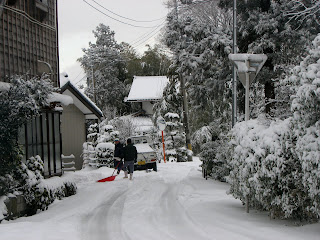


I've said before that Niigata wears its snow well, and the snow does do a lot for sprucing up the drap winter landscape. Unfortunately, it throws the ugly power lines and concrete cube buildings into sharper relief. This is much lamented by Alex Kerr, one of whose books I read not so long ago. He says that the scenic beauty of Japan is having to be increasingly cropped out of photos that contain ever-larger amounts of power lines (which Japanese bureaucrats will not bury on the grounds that Japan has "special soil"), concrete slabs, and so on. As much as I like certain aspects of Japan, this is something I've noticed too, and it puts a damper on things.
Also:
I went on another large, group trip to the Zaou ski area. In terms of Zao as a location itself, it was good or not good for more or less all the same reasons I enumerated in my previous post that dealt with the subject. What was more interesting about this visit was my interaction with my shogakko teachers with whom I went.
The trip revolved, as so many Japanese social events do, around alcohol. The skiing was a secondary consideration- many of the teachers didn't go skiing very often, or weren't particularly interested in skiing per se. To wit- after about one and-a-half hours of meandering skiing, we retired to the lodge for a lunch that consisted of a small snack plate and no fewer than 3 beers (for the record I only had one beer that I cut with a generous plate of curry). This led to some interesting social interactions on the gondola on the way up:
Youngish, married female teacher: Do you like Japanese women?
Me: Sure.
Youngish, married female teacher: Do you think I'm a pretty girl?
Me: (awkward hesitation)
Youngish, married female teacher: You should say yes!
This kind of interaction is a little more typical here (especially after drinking)- so I don't think I was being as overtly hit upon as it might seem to an outside observer, but it was a little disconcerting (what does one say when presented with that situation?).
I can only assume that the beers didn't help with the actual skiing, either, but I was generally the fastest skier and didn't see how the rest of the group fared.
The real business went down at the nomikai that followed the skiing. It started out with a yakiniku (grilled meat) party, which quickly evolved into a drinking party in one of the teacher's hotel rooms. It was here that I learned that the 40something male secretary at my elementary school was studying English by means of his fanatic devotion to Sex and the City, from which he derived a nuanced command of the verb "insert."
The younger teachers all told me right then and there that he was a bit of a henjin BUT, they hastened to add, we are all henjin, after all.
This is actually a pattern of interaction I've observed at more than one nomikai: someone pulls out a label on someone- "hentai, kinky (and its further evolution "king of kinky"), and then "nice guy" have all made the rounds. After this, he hastens to affirm that he (it's usually a male), too, is a kinky/hentai/whathaveyou. After this, it moves around the circle and everyone gets a turn being the labeled one, ending with affirming that "we are all label." Once everyone's had a chance to assume the mantle, the conversation moves on.
This is a behavioral pattern that is, as far as I can tell, unique to Japan's communitarian psychology- and while it may sound silly (and that it is), each person at the nomikai is intensely aware of subtle cues that indicate that a person is feeling overly picked on or left out, and changes are quickly made to correct the discomfort. This results in a party where, toward the end, everyone belongs and a sense of comfort and well-being is pervasive.
Another dynamic made its way to the fore during what can only be termed "manly time" in the onsen after the party. We sat naked in the hot mineral springs, and I learned that some of the teachers were frustrated at two of the teachers who had sat by talking to each other during the party. Being an American, I had thought nothing of it at the time. However, this is Japan, and not participating in the group fun is seen as a slight against the other people there- indicating that perhaps you feel special or superior to or aloof of the other participants. Not only did I learn a bit more about Japanese social interactions, but I was also touched that they included me in their manly venting session as, in every sense of the word "one of the guys." It's nice to be included.
This should (I hope) wrap up the winter-related posts. The weather is getting progressively warmer, and yellow crocuses are already starting to bloom. Future events include- New Guinea trip (expect lots of photographs), taking a look at the sakura (cherry blossoms, for which the peak time is April), and whatever else I can dredge up as Japan moves into warmer weather. With the musical ending, I will suddenly have more weekends free, so expect more information about weekend trips to various locations hereabouts.
That's it for now. Peace all.
Before I show photos of the snow, however, here is a photo of what Arakawa has looked like for most of the winter:

And people wonder why I don't get out much anymore...
This, on the other had, is a little bit of what Arakawa looks like under a real blanket of snow:


I've said before that Niigata wears its snow well, and the snow does do a lot for sprucing up the drap winter landscape. Unfortunately, it throws the ugly power lines and concrete cube buildings into sharper relief. This is much lamented by Alex Kerr, one of whose books I read not so long ago. He says that the scenic beauty of Japan is having to be increasingly cropped out of photos that contain ever-larger amounts of power lines (which Japanese bureaucrats will not bury on the grounds that Japan has "special soil"), concrete slabs, and so on. As much as I like certain aspects of Japan, this is something I've noticed too, and it puts a damper on things.
Also:
I went on another large, group trip to the Zaou ski area. In terms of Zao as a location itself, it was good or not good for more or less all the same reasons I enumerated in my previous post that dealt with the subject. What was more interesting about this visit was my interaction with my shogakko teachers with whom I went.
The trip revolved, as so many Japanese social events do, around alcohol. The skiing was a secondary consideration- many of the teachers didn't go skiing very often, or weren't particularly interested in skiing per se. To wit- after about one and-a-half hours of meandering skiing, we retired to the lodge for a lunch that consisted of a small snack plate and no fewer than 3 beers (for the record I only had one beer that I cut with a generous plate of curry). This led to some interesting social interactions on the gondola on the way up:
Youngish, married female teacher: Do you like Japanese women?
Me: Sure.
Youngish, married female teacher: Do you think I'm a pretty girl?
Me: (awkward hesitation)
Youngish, married female teacher: You should say yes!
This kind of interaction is a little more typical here (especially after drinking)- so I don't think I was being as overtly hit upon as it might seem to an outside observer, but it was a little disconcerting (what does one say when presented with that situation?).
I can only assume that the beers didn't help with the actual skiing, either, but I was generally the fastest skier and didn't see how the rest of the group fared.
The real business went down at the nomikai that followed the skiing. It started out with a yakiniku (grilled meat) party, which quickly evolved into a drinking party in one of the teacher's hotel rooms. It was here that I learned that the 40something male secretary at my elementary school was studying English by means of his fanatic devotion to Sex and the City, from which he derived a nuanced command of the verb "insert."
The younger teachers all told me right then and there that he was a bit of a henjin BUT, they hastened to add, we are all henjin, after all.
This is actually a pattern of interaction I've observed at more than one nomikai: someone pulls out a label on someone- "hentai, kinky (and its further evolution "king of kinky"), and then "nice guy" have all made the rounds. After this, he hastens to affirm that he (it's usually a male), too, is a kinky/hentai/whathaveyou. After this, it moves around the circle and everyone gets a turn being the labeled one, ending with affirming that "we are all label." Once everyone's had a chance to assume the mantle, the conversation moves on.
This is a behavioral pattern that is, as far as I can tell, unique to Japan's communitarian psychology- and while it may sound silly (and that it is), each person at the nomikai is intensely aware of subtle cues that indicate that a person is feeling overly picked on or left out, and changes are quickly made to correct the discomfort. This results in a party where, toward the end, everyone belongs and a sense of comfort and well-being is pervasive.
Another dynamic made its way to the fore during what can only be termed "manly time" in the onsen after the party. We sat naked in the hot mineral springs, and I learned that some of the teachers were frustrated at two of the teachers who had sat by talking to each other during the party. Being an American, I had thought nothing of it at the time. However, this is Japan, and not participating in the group fun is seen as a slight against the other people there- indicating that perhaps you feel special or superior to or aloof of the other participants. Not only did I learn a bit more about Japanese social interactions, but I was also touched that they included me in their manly venting session as, in every sense of the word "one of the guys." It's nice to be included.
This should (I hope) wrap up the winter-related posts. The weather is getting progressively warmer, and yellow crocuses are already starting to bloom. Future events include- New Guinea trip (expect lots of photographs), taking a look at the sakura (cherry blossoms, for which the peak time is April), and whatever else I can dredge up as Japan moves into warmer weather. With the musical ending, I will suddenly have more weekends free, so expect more information about weekend trips to various locations hereabouts.
That's it for now. Peace all.
Subscribe to:
Posts (Atom)
